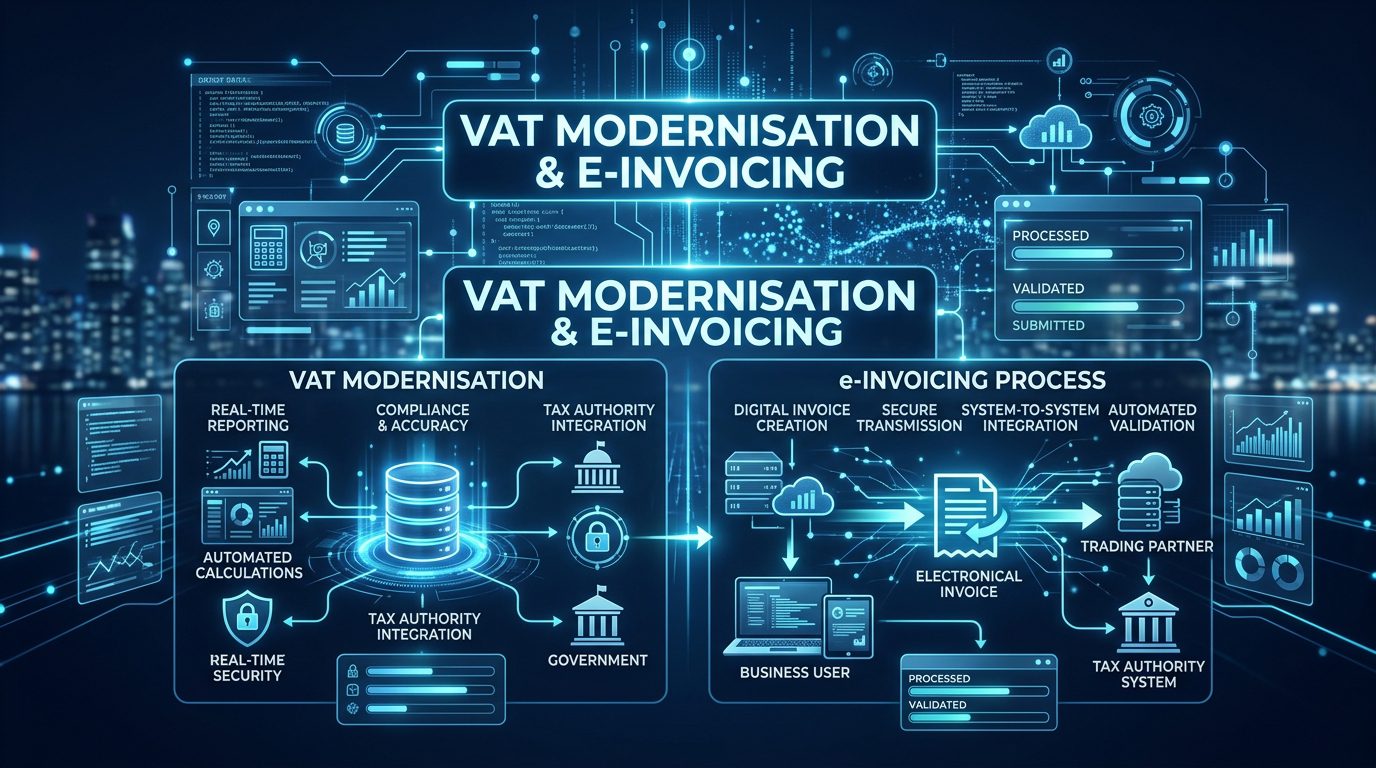
VAT Modernisation in South Africa: Draft Tax Amendments Lay the Foundation for Real-Time Reporting
South Africa has taken a decisive step toward VAT Modernisation. With National Treasury’s release of the 2025 Draft Taxation and Tax Administration Amendment Bills, we are now seeing legislative changes that formally establish the foundations for real-time VAT reporting and e-invoicing.
This marks the beginning of a fundamental shift in how VAT will be administered in South Africa. For the first time, the legislation includes new e-invoicing definitions that form the foundations to enable voluntary e-reporting — clear signals of government’s intent to transition toward a digital-first tax environment.
Why These Draft Amendments Matter
The proposed changes are not just technical adjustments; they pave the way for a system where businesses will transmit VAT data and invoices digitally, in real time, directly to SARS.
This shift promises significant benefits:
- Simplified compliance through automated digital processes.
- Reduced errors and fraud, thanks to real-time data validation.
- Increased transparency, as SARS and taxpayers access the same information simultaneously.
- A stronger, more efficient tax ecosystem that helps to narrow South Africa’s estimated R800 billion tax gap.
What Will South Africa’s VAT Modernisation Framework Look Like?
While the amendments introduce new e-invoicing definitions and provide the legal basis for reform, the exact regulatory framework for VAT Modernisation in South Africa is not yet defined. However, businesses should be aware that:
- Different countries have adopted different models for e-invoicing and VAT reporting.
- Treasury has indicated that South Africa will likely follow a decentralised clearance model with continuous transaction controls (CTCs).
- Under such a model, invoices flow between trading partners in real time, with tax authorities able to monitor transactions continuously.
Examples of countries that currently operate with a decentralised model include Mexico, Peru, and Chile. These nations have demonstrated that e-invoicing can significantly narrow VAT collection gaps and improve compliance, while also reducing opportunities for fraud and error.
Although the exact design of South Africa’s system is still to be detailed, the trajectory is clear: businesses will need to further digitise their invoicing and VAT processes in order to prepare for real-time data exchange with SARS.
What This Means for Businesses
While the long-term benefits are clear, the transition will be a significant adjustment for businesses. Real-time reporting means SARS will have visibility into VAT data at the same time as companies. This elevates the importance of data accuracy, governance, and digital readiness.
Those who start early will be better positioned to transition smoothly, minimise disruption, and even find efficiencies in their finance and tax operations.
Why Being Proactive Is Essential
Although the full implementation of the VAT Modernisation Project is targeted for 2028, the release of the draft amendments is a strong signal: change is no longer theoretical — it’s in motion. It’s therefore time to start adapting.
Now is the time to:
- Assess your existing invoicing and reporting systems.
- Strengthen data quality and processes.
- Explore e-invoicing solutions that can integrate seamlessly into your existing operations.
How We Can Help
At VAT Modernisation SA, our mission is to ensure that South African businesses are fully prepared for this upcoming transformation. We help organisations adopt cost-effective, easy-to-implement e-invoicing solutions that integrate with existing systems — ensuring compliance without disrupting business as usual.
The sooner you start preparing, the smoother your journey to real-time VAT reporting will be. With the groundwork now being laid through these draft amendments, the time to act is now.