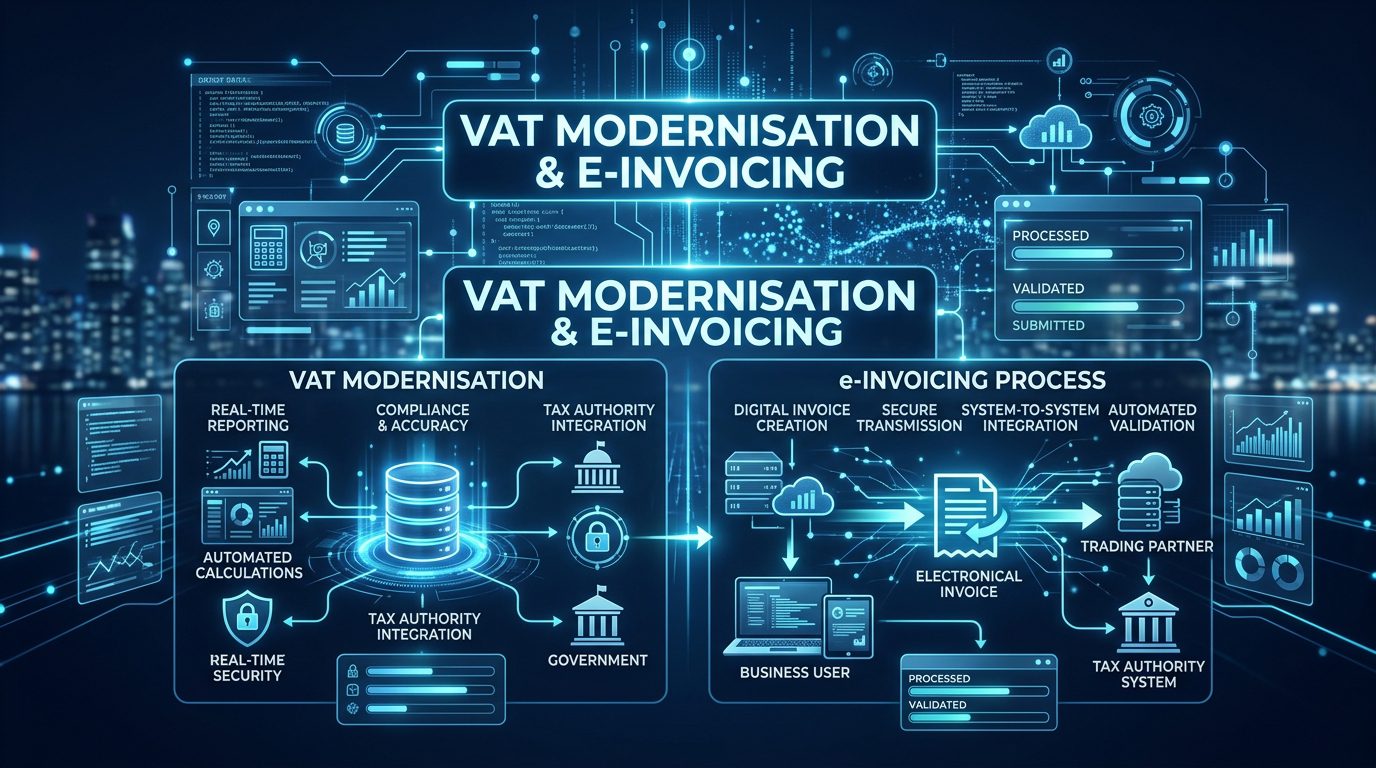
Beyond Compliance: How E-Invoicing Becomes a Launchpad for Intelligent Finance
E-invoicing is gaining momentum because governments want better tax compliance. That is the push factor. The pull factor is more interesting.
When invoice data becomes structured, standardised, and real-time, it stops living in silos and static documents. It turns into an infrastructure layer that feeds AI models, embedded analytics, and new finance products. That is where the real value now sits.
A 2025 global study by Avalara and the Centre for Economics and Business Research estimates that full e-invoicing adoption across six major markets could unlock about $616 billion in annual economic gains through productivity improvements, faster payments, and reduced fraud.
The question for finance leaders in 2026 is no longer whether e-invoicing will arrive. It’s how to use it as a springboard for a more intelligent finance function.
1. Structured invoice data becomes the new backbone of finance
Traditional invoices are unstructured documents. Humans can read them. Systems struggle. That is why so much effort in AR and AP still goes into rekeying, interpreting, and reconciling.
E-invoicing flips that pattern. Data is created as machine-readable from the start, which means it can flow directly between ERPs, tax platforms, banks, and analytics tools without manual intervention.
Institutions such as ICAEW now describe e-invoicing as a key enabler of long-term economic growth because it reduces friction, boosts productivity, and lays the groundwork for broader digital transformation through structured data.
For finance teams, that structure changes three things immediately:
-
- Cash and risk positions are visible across entities and regions instead of buried in local systems.
-
- Matching and approvals can be built directly into finance workflows, with invoices automatically matched to purchase orders, delivery notes, and approval thresholds instead of being chased through email threads.
-
- Every invoice adds clean data to the organisation’s analytical and AI models.
Compliance is the reason these projects get approved. The data backbone is where the lasting value comes from.
2. Real-time visibility shifts finance from reporting to directing
Once all invoices flow through a single digital channel, visibility stops being a month-end exercise and becomes continuous.
Automated e-invoicing can shorten settlement cycles by five to seven days and reduce per-invoice processing costs, while giving finance teams real-time insight into outstanding payables and receivables.
That shift in timing changes how leaders operate:
-
- Treasury can adjust funding decisions based on live inflow and outflow projections.
-
- AR can see where disputes are forming and intervene before customers fall into chronic delay patterns.
-
- CFOs get a single view of working capital that reflects what is happening this week, not last quarter.
For multi-party environments, such as logistics platforms or multi-entity groups, e-invoicing goes further. Once partners exchange structured invoices over standard rails, reconciliation and performance monitoring can happen across the entire network, not just inside one organisation’s ERP.
3. New workflows become possible when data arrives clean
Many automation initiatives stalled in the past because underlying data was inconsistent. Workflows built on scanned PDFs or emailed spreadsheets simply did not have enough reliability to support full straight-through processing.
E-invoicing changes that by forcing discipline at the point of capture. Invoices arrive in a standard format, with mandatory fields validated before they enter downstream systems.
Vendors in AP and AR automation now report that, when this foundation is in place, organisations can cut processing costs by up to 80% and significantly reduce invoice cycle times, because the system can route, match, and approve most items autonomously.
For finance teams, that unlocks workflows that simply did not scale before, such as:
-
- Automated three-way and four-way matching between invoices, purchase orders, receipts, and contracts.
-
- Policy-based approval routing where thresholds, categories, and risk scores determine the path without manual triage.
-
- Continuous vendor validation and duplicate detection, reducing the risk of fraud and overpayment.
Once those workflows run on structured data, human effort can move to exceptions, negotiations, and planning instead of checking whether the numbers line up.
4. E-invoicing lays the groundwork for AI and embedded analytics
AI in finance depends on the quality, consistency, and volume of underlying data. E-invoicing is one of the most reliable sources of that data because it sits at the intersection of tax, commercial terms, and cash movement.
Recent industry work on e-invoicing and integrated digital trade highlights that widespread adoption will not only deliver short-term productivity gains but also accelerate digitisation across the wider economy and pave the way for broader AI use in finance.
Once invoice data is structured and centralised, AI models can:
-
- Predict cash flows at invoice, customer, or segment level with far greater accuracy.
-
- Flag pricing anomalies, unusual vendor behaviour, and emerging disputes before they appear in aging reports.
-
- Optimise payment timing based on discount opportunities, supplier risk, and funding costs.
Embedded analytics then turns these outputs into live tools. Dashboards inside the ERP or e-invoicing platform can show real-time spend by category, margin by customer, and vendor performance, without a separate data integration project.
In practice, invoices evolve from static records of what happened into signals about what should happen next.
5. Interoperability opens doors for cross-border growth and new products
E-invoicing is also driving standardisation between countries and platforms. Governments and solution providers are converging on frameworks such as Peppol and other continuous transaction control models, which allow secure exchange of structured documents across borders and systems.
This interoperability unlocks several opportunities:
-
- Expansion into new markets with lower administrative overhead, because invoices flow over familiar rails that already align with local rules.
-
- Easier collaboration with banks and fintechs that can underwrite working capital, dynamic discounting, and supply chain finance based on live invoice data rather than historic statements.
-
- Stronger audit trails that support both tax authorities and external funders, improving access to credit and investment.
The move toward standardised e-invoicing is not just a tax trend. It is creating a common language for digital trade that finance can use to support growth.
6. What forward-looking finance teams should prioritise in 2026
For finance leaders planning their next phase of e-invoicing, three priorities will matter most.
Design for reuse, not just reporting
Treat every invoice as a data asset that should feed AR, AP, tax, credit, and analytics simultaneously. That means pushing for rich data capture and standardised formats, rather than minimum viable compliance.
Insist on open, integrated architectures
Choose platforms that can plug directly into your ERP and analytics stack, and that support recognised standards. A lack of integration will limit how far you can extend the value of your data over time.
Use e-invoicing as the starting point for AI
Once the structured data is in place, focus your AI pilots where the link to invoices is strongest: working capital forecasting, anomaly detection, credit risk scoring, and dispute prediction. These use cases benefit directly from the quality and timeliness of e-invoice data.
The common thread is simple: treat e-invoicing as infrastructure, not as a form-filling exercise.
Industry perspectives: how e-invoicing is already opening new doors
VAT Modernisation SA, recently conducted an international survey examining how global businesses are moving beyond compliance and unlocking value from e-invoicing. The insights below reflect some of the most consistent themes that emerged:
“The most tangible innovation e-invoicing unlocked for us was real-time financial visibility across our entire network. Structured e-invoices cut our month-end close from 12 days to 4, improved our receivables cycle by 35%, and reduced dispute resolution time by over 60%. With years of clean data, we are now building predictive models that forecast cash flow and flag anomalies before they become problems.”
-
- Joe Spisak, CEO, Fulfill.com
“Once a company standardizes invoice formats and ingestion, it becomes much easier to build automated matching between invoices, purchase orders, and receipts. What used to require manual review can be embedded into the workflow itself, reducing cycle times and cutting down on exceptions that bottleneck teams. Looking ahead, the broader opportunity lies in interoperability and cloud-based finance ecosystems that operate with far less friction.”
-
- Dennis Shirshikov, Head of Growth and Engineering, Growthlimit.com
“E-invoicing tends to start as a compliance exercise, but very quickly you realize that it forces a level of structure and discipline that the rest of your finance stack benefits from. With e-invoicing, the system can compare invoices to purchase orders and receipt confirmations in real time. Cash flow forecasting becomes more accurate because invoicing data is updated continuously rather than in end-of-week batches.”
-
- Christopher Ledwidge, Co-Founder & Executive Vice President of Retail Lending, theLender.com
“E-invoicing often enters the conversation as a mandate, but its real power shows up once everything is standardized, digital, and structured. One of the most meaningful improvements I have seen is the ability to automate multi-step approval workflows that used to live in email threads. With continuous insight into payables, leadership can understand burn, vendor concentration, and operational risk earlier, and make timing-sensitive decisions with far more confidence.”
-
- Mada Seghete, Co-founder and CEO, Upside.tech
These voices reflect a common pattern. Compliance may be the starting line, but the real gains arrive once e-invoicing becomes the data foundation for intelligent, connected finance.
For AR and AP leaders planning 2026, that is the opportunity worth aiming for.